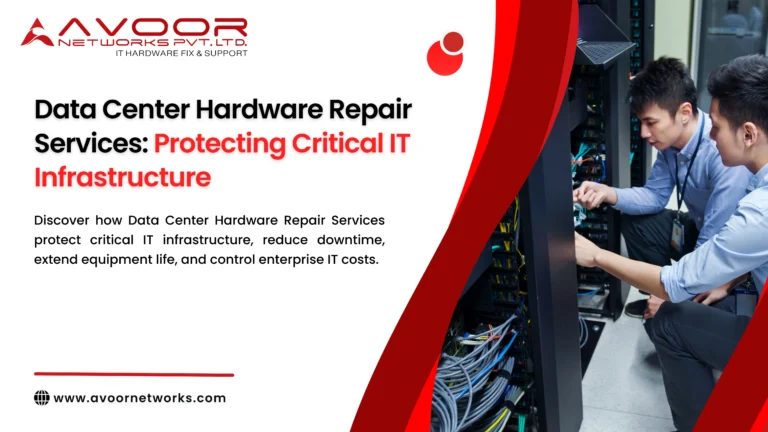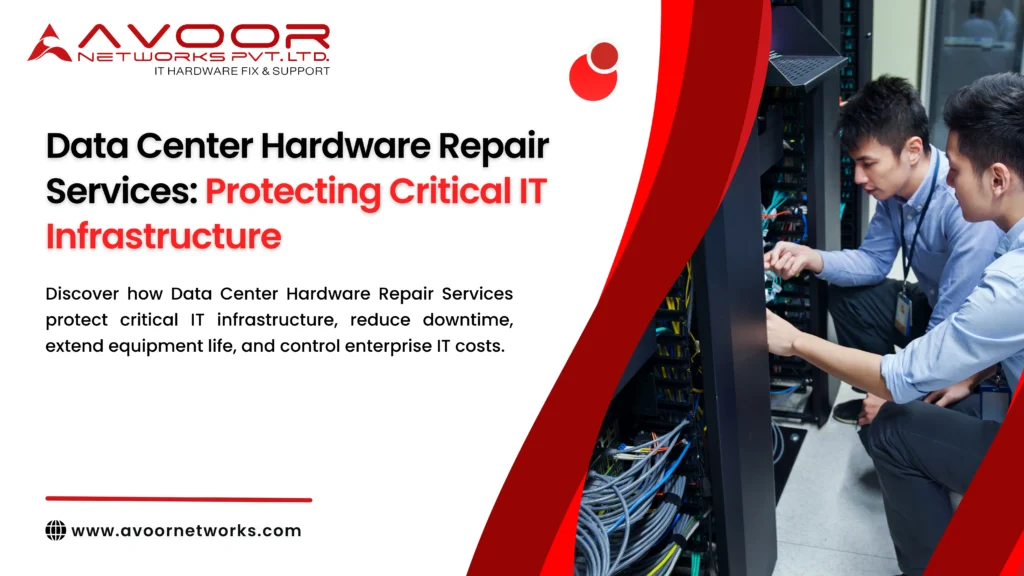
Data Center Hardware Repair Services play a vital role in keeping modern businesses operational. Data centers are the foundation of digital services, hosting servers, networking equipment, storage systems, security appliances, and other infrastructure that businesses depend on every day.
A single hardware failure can have consequences far beyond one defective device. A failed core switch can interrupt connectivity. A faulty router can disconnect an entire location. A failed firewall can affect internet access and security. A storage controller problem can prevent applications from accessing critical data.
For this reason, data center hardware management should not focus only on replacing failed equipment. Businesses need a complete strategy that combines preventive maintenance, hardware monitoring, redundancy, professional repair, spare equipment, lifecycle planning, and rapid recovery.
At Avoor Networks Pvt. Ltd., we have more than 26 years of experience providing enterprise network hardware repair, server and storage repair, chip-level diagnostics, preventive maintenance, AMC/CAMC services, refurbished equipment, and PAN India support.
This guide explains how professional Data Center Hardware Repair Services can help businesses protect critical IT infrastructure, reduce downtime, and maximize the useful life of enterprise hardware.
Table of Contents
- What Are Data Center Hardware Repair Services?
- Why Data Center Hardware Reliability Matters
- 10 Ways Professional Repair Protects IT Infrastructure
- Common Data Center Hardware Failures
- Router and Switch Repair
- Firewall Hardware Repair
- Server and Storage Repair
- The Role of Chip-Level Repair
- Preventive Data Center Hardware Maintenance
- Repair vs Replacement
- EOL and Legacy Data Center Equipment
- AMC and CAMC Services
- Data Center Hardware Emergency Response
- Why Choose Avoor Networks?
- Frequently Asked Questions
- Conclusion
What Are Data Center Hardware Repair Services?
Data Center Hardware Repair Services involve the professional diagnosis, repair, testing, and restoration of physical IT equipment used in data center environments.
These services can cover:
- Enterprise routers
- Network switches
- Core switches
- Data center switches
- Firewalls
- Servers
- Storage systems
- SAN equipment
- Network modules
- Power supplies
- Cooling components
- RAID controllers
- Storage controllers
- Network interfaces
Depending on the equipment and fault, repair may involve component replacement, PCB-level diagnostics, chip-level repair, module replacement, or other hardware restoration techniques.
The objective is to restore suitable equipment to reliable working condition while minimizing disruption to business operations.
Why Data Center Hardware Reliability Matters
Modern organizations depend on continuous access to IT systems.
Data center infrastructure may support:
- Enterprise applications
- Databases
- Cloud services
- Websites
- E-commerce platforms
- Customer portals
- Communication systems
- ERP applications
- Backup systems
- Security platforms
- Storage infrastructure
When critical hardware fails, even a short interruption can affect multiple business functions.
This makes Data Center Hardware Repair Services an important part of business continuity planning.
10 Ways Data Center Hardware Repair Services Protect IT Infrastructure
1. Reduce the Impact of Unexpected Hardware Failures
Hardware failures cannot always be predicted.
However, organizations can reduce their impact by having a professional repair process already established.
A documented repair process can help IT teams quickly:
- Identify the failed device.
- Determine its business impact.
- Activate redundancy or a spare.
- Diagnose the hardware.
- Repair or replace the failed component.
- Test the equipment.
- Return it to service.
This approach helps prevent an isolated hardware problem from becoming a prolonged outage.
2. Extend the Life of Valuable Enterprise Equipment
Enterprise hardware represents a significant investment.
Replacing equipment every time a component fails can increase IT expenditure unnecessarily.
Professional repair can potentially extend the life of equipment that remains:
- Reliable
- Secure
- Performance-capable
- Compatible with the existing environment
This is particularly useful for expensive data center routers, switches, servers, storage systems, and specialized equipment.
3. Reduce Hardware Replacement Costs
A complete device replacement is not always necessary.
For example, a network switch may have a faulty power circuit while the rest of the hardware remains operational.
A professional technician can diagnose the fault and determine whether the affected component or PCB can be repaired.
This can potentially reduce the cost of maintaining the infrastructure.
However, cost should not be the only consideration. IT Managers should also evaluate equipment age, security support, performance, reliability, and lifecycle status.
4. Support Business Continuity
Data center equipment should be managed with business continuity in mind.
Professional repair services can complement:
- Redundant network architecture
- High-availability systems
- Backup infrastructure
- Spare hardware
- Disaster recovery plans
- Configuration backups
For example, if a redundant switch fails, the backup switch can maintain connectivity while the failed unit is sent for repair.
Once repaired and tested, the device can return to the spare inventory.
5. Provide Specialized Chip-Level Repair
One of the most valuable capabilities in advanced hardware repair is chip-level diagnostics and repair.
Instead of automatically replacing an entire motherboard or PCB, engineers inspect the circuit to identify the faulty component.
Components that may be evaluated include:
- Power ICs
- Voltage regulators
- MOSFETs
- Capacitors
- Resistors
- Memory components
- Controller ICs
- Network interface circuits
- Connectors
Chip-level repair is especially valuable for legacy equipment where replacement boards may be difficult or expensive to obtain.
6. Support Legacy and EOL Data Center Equipment
Data centers often contain hardware from different generations.
Some equipment may be:
- Current
- Older but supported
- End-of-Sale
- End-of-Life
- End-of-Support
Businesses may continue using suitable legacy equipment because replacing it immediately can be expensive or operationally disruptive.
Professional Data Center Hardware Repair Services can sometimes provide a practical maintenance option for suitable EOL hardware.
However, organizations should separately evaluate:
- Security updates
- Software support
- Compliance
- Spare availability
- Performance
- Business continuity risk
7. Reduce Repair Turnaround Time
A professional repair partner can establish a defined workflow for collecting, diagnosing, repairing, testing, and returning equipment.
This can be especially important for:
- Core networking equipment
- Critical firewalls
- Storage controllers
- High-value servers
- Specialized data center hardware
The faster a failed component is diagnosed, the sooner the IT team can determine whether to repair, replace, or activate a spare.
8. Improve Preventive Maintenance
Repair should not be limited to equipment that has already failed.
A strong data center maintenance program should identify early warning signs.
IT teams should monitor:
- Temperature
- Fan status
- Power supply health
- Hardware alerts
- Interface errors
- Packet loss
- Memory errors
- Storage health
- Unexpected reboots
Preventive maintenance can identify problems before they become critical incidents.
9. Improve Hardware Lifecycle Management
Professional repair data can reveal patterns that are useful for lifecycle planning.
For example, if a particular model begins experiencing frequent power or cooling failures, IT Managers can identify it as a replacement priority.
Maintain records for:
- Device model
- Serial number
- Installation date
- Repair history
- Failure frequency
- EOL/EOS status
- Spare availability
- Business criticality
This turns hardware repair from a reactive service into part of a broader IT asset management strategy.
10. Reduce Unnecessary Electronic Waste
Repairing suitable equipment can keep hardware operational for longer.
Instead of immediately disposing of a device because one component has failed, professional diagnostics can determine whether it can be economically restored.
This approach can support more sustainable IT asset management while reducing unnecessary equipment replacement.
Common Data Center Hardware Failures
Data center equipment can experience a wide range of hardware problems.
Power Supply Failure
Symptoms may include:
- No power
- Unexpected shutdowns
- Reboots
- PSU alarms
- Unstable operation
Overheating
Potential causes include:
- Failed fans
- Dust
- Blocked airflow
- High room temperature
- Component degradation
Network Port Failure
Ethernet, SFP, SFP+, and QSFP interfaces can experience hardware faults.
Motherboard Failure
PCB components can deteriorate due to age, heat, power fluctuations, or electrical events.
Controller Failure
Servers and storage systems may experience RAID, storage, or network controller failures.
Fan Failure
A failed cooling fan can increase temperatures and contribute to more serious component damage.
Router and Switch Repair for Data Centers
Routers and switches are among the most critical components in data center networking.
A failed core switch can affect communication between:
- Servers
- Storage
- Firewalls
- Load balancers
- Internet connections
- Branch networks
Professional switch repair services may investigate:
- Power systems
- Ethernet ports
- SFP/SFP+ interfaces
- QSFP interfaces
- Cooling systems
- Motherboards
- PCB components
Similarly, router repair services can address hardware problems involving power supplies, interfaces, motherboards, and other components.
Firewall Hardware Repair
Firewalls provide an important security boundary for many enterprise environments.
A hardware failure can affect both connectivity and security.
Common firewall hardware problems include:
- Power failure
- Boot failure
- Interface failure
- Cooling problems
- Power supply faults
- Motherboard faults
A repair assessment should consider not only whether the hardware can be restored but also whether the platform continues to receive necessary security updates.
Server and Storage Hardware Repair
Data centers depend on servers and storage systems as much as they depend on network infrastructure.
Server Repair
Common server hardware problems include:
- Motherboard failure
- Power supply failure
- Memory faults
- RAID controller problems
- Backplane faults
- Cooling problems
Storage Repair
Storage hardware can experience:
- Controller failure
- RAID controller problems
- Power module failure
- Fan failure
- Backplane problems
- Interface faults
Storage failures should be handled carefully because hardware problems can potentially affect data availability.
Organizations should always maintain appropriate backups and recovery procedures.
The Role of Chip-Level Repair
Chip-level repair can be a valuable component of professional Data Center Hardware Repair Services.
Instead of replacing an entire board, engineers may identify a failed electronic component and determine whether it can be repaired or replaced.
Potential benefits include:
- Lower repair costs
- Extended hardware lifespan
- Support for legacy equipment
- Reduced replacement requirements
- Reduced electronic waste
Chip-level repair is not suitable for every failure. Equipment should undergo proper diagnosis before a repair decision is made.
Preventive Data Center Hardware Maintenance
A preventive maintenance program should be structured around the criticality of each device.
Daily
- Monitor hardware alerts
- Check critical temperatures
- Review power warnings
- Monitor network connectivity
Weekly
- Review interface errors
- Check fan status
- Review system logs
- Verify configuration backups
Monthly
- Inspect equipment condition
- Review rack airflow
- Check cable connections
- Review spare inventory
Quarterly
- Perform detailed hardware inspection
- Review recurring failures
- Test redundancy
- Review lifecycle status
Annually
- Review EOL/EOS status
- Evaluate hardware replacement priorities
- Review AMC/CAMC coverage
- Update the disaster recovery plan
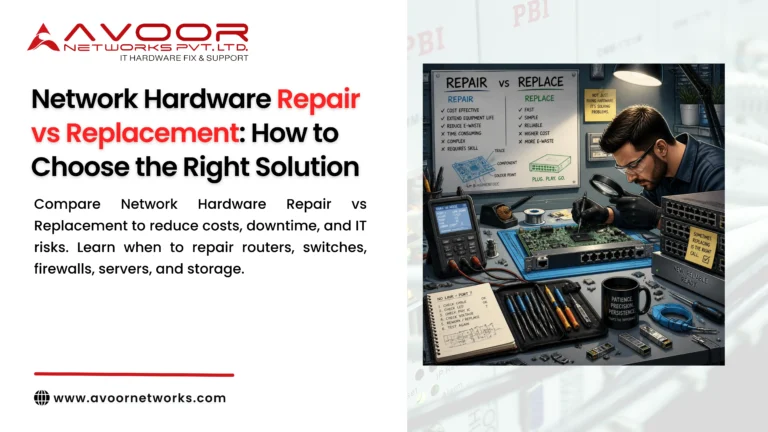
Repair vs Replacement
Not every failed data center device should be repaired.
Repair May Be Suitable When:
- The hardware remains reliable apart from an isolated fault.
- Performance is still sufficient.
- Security requirements are satisfied.
- Replacement hardware is expensive.
- Repair is economically practical.
- Compatible components are available.
Replacement May Be Better When:
- Hardware failures are recurring.
- Security support has ended.
- Performance is inadequate.
- Spare parts are unavailable.
- Repair cost is close to replacement cost.
- The device creates unacceptable business risk.
A professional assessment can help IT Managers make an informed decision.
EOL and Legacy Data Center Equipment
End-of-life hardware can present both challenges and opportunities.
The main risks include:
- Limited manufacturer support
- Reduced spare availability
- Lack of security updates
- Increasing failure rates
- Compatibility issues
However, suitable legacy hardware may still be operationally useful.
Data Center Hardware Repair Services can help maintain selected legacy systems while businesses prepare a controlled migration plan.
The key is to avoid treating repair as a permanent substitute for modernization.
AMC and CAMC for Data Center Hardware
Annual Maintenance Contracts can provide a structured way to manage enterprise hardware.
Depending on contractual terms, AMC services may include:
- Preventive maintenance
- Hardware inspections
- Diagnostics
- Repair coordination
- Technical support
Comprehensive AMC arrangements may provide broader repair and parts coverage.
For organizations operating multiple data centers or large hardware inventories, maintenance contracts can simplify support and escalation.
Data Center Hardware Emergency Response
When critical equipment fails, every minute can matter.
A practical emergency response process should include:
1. Identify the Device
Record the model, serial number, location, and business function.
2. Determine Business Impact
Establish which services and users are affected.
3. Activate Redundancy
Move traffic or services to available redundant infrastructure where possible.
4. Preserve Configurations
Ensure current configurations and relevant logs are backed up.
5. Diagnose the Hardware
Determine whether the problem is power, interface, cooling, PCB, controller, or another hardware issue.
6. Repair or Replace
Use a spare or send the equipment for professional repair based on the recovery plan.
7. Test Before Deployment
Never return repaired equipment to a critical environment without appropriate functional testing.
Why Choose Avoor Networks Pvt. Ltd.?
With more than 26 years of industry experience, Avoor Networks Pvt. Ltd. provides professional enterprise and data center hardware repair services across India.
Our capabilities include:
- Data Center Hardware Repair Services
- Enterprise Network Hardware Repair
- Router Repair
- Switch Repair
- Firewall Repair
- Server Repair
- Storage Repair
- Chip-Level Diagnostics and Repair
- EOL and Legacy Hardware Support
- Refurbished Networking Equipment
- Preventive Maintenance
- AMC Services
- CAMC Services
- Multi-Brand Hardware Support
- PAN India Pickup and Delivery
We support equipment from multiple enterprise manufacturers, including Cisco, Juniper Networks, HPE, Dell, Fortinet, Aruba, Palo Alto Networks, Extreme Networks, IBM, Lenovo, Brocade, NetApp, Huawei, and others.
Repair feasibility depends on the specific model, fault, component availability, and equipment condition.
Conclusion
Data Center Hardware Repair Services are an important part of protecting critical IT infrastructure. While hardware failures cannot always be prevented, organizations can significantly reduce their impact through proactive monitoring, preventive maintenance, redundancy, spare equipment, professional diagnostics, and a well-defined repair strategy.
Repairing suitable equipment can also help businesses extend hardware life and control IT expenditure. For legacy and EOL equipment, professional repair can provide valuable additional time to plan a controlled modernization strategy.
The most effective approach is not simply to repair every failed device. IT Managers should evaluate reliability, security, performance, lifecycle status, repair cost, spare availability, and business criticality before deciding whether to repair or replace.
With more than 26 years of experience, Avoor Networks Pvt. Ltd. provides professional Data Center Hardware Repair Services, enterprise network equipment repair, chip-level diagnostics, server and storage repair, EOL support, preventive maintenance, AMC/CAMC services, and refurbished equipment solutions across India.
Protect Your Critical Data Center Infrastructure
Don’t wait for a critical hardware failure to disrupt business operations.
Contact Avoor Networks Pvt. Ltd. for professional Data Center Hardware Repair Services, hardware diagnostics, chip-level repair, preventive maintenance, and PAN India enterprise hardware support.