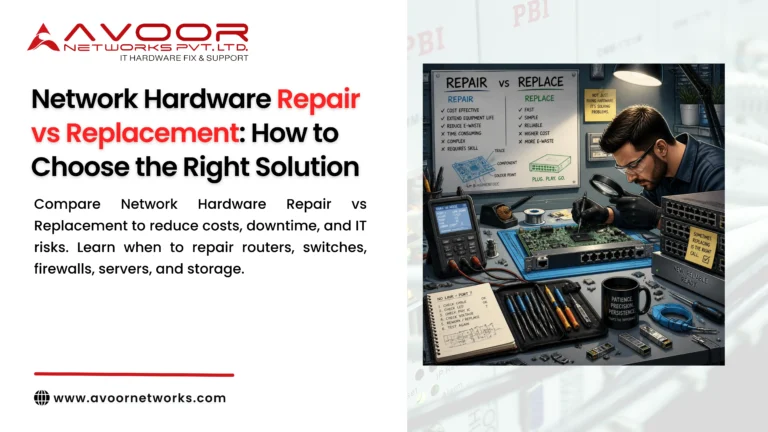
Multi-Brand Network Hardware Repair Services have become increasingly important for businesses operating complex IT environments.
Modern enterprises rarely depend on equipment from just one manufacturer. A typical data center or corporate network may contain routers, switches, firewalls, servers, storage systems, wireless controllers, and network modules from several different brands.
For IT Managers, this creates a practical challenge.
When hardware fails, finding separate repair providers for every manufacturer can make troubleshooting, logistics, communication, and vendor management unnecessarily complicated.
A professional Multi-Brand Network Hardware Repair Services provider can offer a centralized solution for diagnosing, repairing, testing, and maintaining equipment from multiple manufacturers.
This approach can help businesses reduce downtime, control repair costs, extend hardware lifespan, support legacy equipment, and simplify IT infrastructure management.
At Avoor Networks Pvt. Ltd., we have more than 26 years of experience supporting enterprise networking and IT hardware across India, including router and switch repair, firewall repair, server and storage repair, chip-level diagnostics, EOL hardware support, preventive maintenance, AMC/CAMC services, and refurbished equipment.
This guide explains why businesses choose professional multi-brand hardware repair services and what IT Managers should consider when selecting a repair partner.
What Are Multi-Brand Network Hardware Repair Services?
Multi-Brand Network Hardware Repair Services provide diagnosis, repair, testing, and maintenance support for networking and IT equipment manufactured by different vendors.
Instead of maintaining separate relationships with multiple repair companies, an organization can work with one experienced service provider for a broader range of equipment.
Depending on the provider’s capabilities, this can include:
- Enterprise routers
- Network switches
- Core switches
- Data center switches
- Firewalls
- Servers
- Storage systems
- Network modules
- Power supplies
- Cooling components
- Network interface modules
- Controllers
- Enterprise PCB assemblies
Repair may involve module replacement, component-level repair, PCB diagnostics, chip-level repair, or other suitable techniques.
Why Businesses Use Multiple Network Hardware Brands
There are several reasons organizations operate multi-vendor networks.
A business may select different manufacturers based on:
- Performance
- Pricing
- Features
- Existing infrastructure
- Application requirements
- Security requirements
- Vendor preference
- Acquisition history
- Data center standards
For example, an organization may use one vendor for core switching, another for firewalls, another for servers, and another for storage.
This creates a diverse hardware environment.
When equipment fails, IT teams need repair expertise that can handle this diversity.
9 Reasons Businesses Choose Multi-Brand Network Hardware Repair Services
1. One Repair Partner for Multiple Brands
One of the biggest advantages is simplicity.
Instead of maintaining different repair vendors for different manufacturers, businesses can use one experienced partner for multiple equipment categories.
This can simplify:
- Service coordination
- Communication
- Logistics
- Documentation
- Escalation
- Repair tracking
- Vendor management
For large IT environments, centralized repair management can save considerable administrative effort.
2. Reduce Network Hardware Downtime
Hardware failure can interrupt critical business operations.
A failed router may disconnect a branch.
A failed switch may affect multiple servers.
A failed firewall may disrupt internet access.
A storage controller failure may affect application availability.
Professional Multi-Brand Network Hardware Repair Services can provide a structured process for rapid diagnosis and repair.
The objective is to identify the fault quickly and determine the fastest practical recovery option.
3. Lower Hardware Replacement Costs
Not every hardware failure requires complete equipment replacement.
A device may fail because of a relatively isolated problem involving:
- Power supply
- Voltage regulator
- Network port
- Cooling system
- PCB component
- Controller
- Interface circuit
Professional diagnosis can determine whether the equipment can be repaired.
If the equipment remains suitable for business requirements, repair may cost less than purchasing a new replacement.
This can be particularly valuable for expensive enterprise and data center hardware.
4. Support Legacy and EOL Equipment
Many organizations continue operating older hardware because immediate replacement is expensive or disruptive.
Some devices may be:
- Legacy
- End-of-Sale
- End-of-Life
- End-of-Support
Manufacturer support may be limited or unavailable.
A specialist multi-brand repair provider can sometimes extend the usable life of suitable legacy equipment.
This can give businesses additional time to:
- Plan migration
- Allocate budget
- Test replacement equipment
- Schedule downtime
- Complete infrastructure upgrades
However, EOL equipment should always be evaluated for security, compliance, performance, and business continuity risks.
5. Access to Specialized Chip-Level Repair
Multi-brand repair providers with advanced technical capabilities can go beyond basic part replacement.
Chip-level repair involves diagnosing individual electronic components on a PCB.
Potentially affected components include:
- Integrated circuits
- Voltage regulators
- MOSFETs
- Capacitors
- Resistors
- Memory components
- Controllers
- Interface circuits
This can be especially useful when replacement boards are expensive or difficult to source.
For legacy equipment, chip-level repair can sometimes provide a practical alternative to replacing the entire device.
6. Simplify Enterprise IT Asset Management
A centralized repair partner can help organizations maintain consistent repair records.
Important information includes:
- Manufacturer
- Model
- Serial number
- Device location
- Fault description
- Repair history
- Repair cost
- Date of service
- EOL/EOS status
- Spare availability
Over time, these records can help IT Managers identify:
- Frequently failing models
- High-maintenance equipment
- Replacement priorities
- Recurring hardware problems
This makes hardware repair part of a broader IT lifecycle management strategy.
7. Improve Spare Hardware Management
Multi-brand repair services can also support a strategic spare inventory.
For example, an enterprise may maintain backup:
- Switches
- Routers
- Power supplies
- Network modules
- SFP/SFP+ modules
- QSFP modules
- Server components
- Storage controllers
When a production device fails, a compatible spare can be deployed while the failed equipment is repaired.
Once repaired and tested, the device can return to the spare inventory.
This creates a cycle that helps maintain operational resilience.
8. Reduce Vendor Management Complexity
Managing multiple repair companies can create unnecessary administrative work.
IT teams may need to maintain:
- Multiple contracts
- Different escalation procedures
- Different service levels
- Separate invoices
- Different logistics arrangements
- Multiple technical contacts
A capable multi-brand repair partner can consolidate much of this activity.
For larger organizations, this can make hardware support easier to manage.
9. Support Mixed-Vendor Data Center Environments
Data centers often contain infrastructure from many manufacturers.
For example, an environment may include:
- Cisco networking equipment
- Juniper networking equipment
- HPE servers
- Dell servers
- Fortinet firewalls
- Aruba networking equipment
- NetApp storage
- Lenovo servers
A multi-brand repair capability can be particularly valuable in such environments.
Instead of asking, “Which vendor supports this device?”, the IT team can start with a single hardware support partner.
What Equipment Can Be Repaired?
Professional Multi-Brand Network Hardware Repair Services may cover several categories.
Routers
Common hardware faults include:
- Power failures
- Interface failures
- PCB problems
- Cooling issues
- Component failures
Switches
Repair may involve:
- Power supply
- Ethernet ports
- SFP/SFP+ ports
- QSFP interfaces
- Motherboards
- Cooling components
Firewalls
Possible hardware failures include:
- Power problems
- Interface faults
- Cooling issues
- PCB faults
- Boot-related hardware problems
Security lifecycle should be evaluated separately before continuing to operate older firewall platforms.
Servers
Potential repair areas include:
- Motherboards
- Power supplies
- Memory
- RAID controllers
- Backplanes
- Fans
Storage Systems
Storage repair may include:
- Controllers
- Power modules
- Backplanes
- Interface components
- Cooling systems
Data protection should always be prioritized when working with storage infrastructure.
Benefits for Data Centers and Enterprise IT Teams
A professional multi-brand repair strategy can provide several operational benefits.
Lower Capital Expenditure
Repairing suitable equipment can reduce the need for immediate hardware purchases.
Faster Recovery
A structured repair process can help reduce the time required to restore failed hardware.
Better Lifecycle Planning
Repair history helps identify equipment that should eventually be replaced.
Simplified Support
One repair partner can support multiple equipment categories.
Better Spare Management
Repaired equipment can potentially be returned to the spare inventory.
Extended Hardware Lifespan
Suitable equipment can remain operational for longer.
The Role of Chip-Level Repair
Traditional hardware repair sometimes involves replacing an entire module or board.
Chip-level repair takes a more detailed approach.
Engineers investigate the actual PCB and identify defective electronic components.
This approach may be useful when:
- The equipment is expensive.
- Replacement boards are unavailable.
- The hardware is legacy.
- The fault is isolated.
- The device otherwise remains reliable.
However, chip-level repair should only be performed when technically appropriate and followed by proper functional testing.
Multi-Brand Repair vs Manufacturer-Only Support
Both approaches have a place in enterprise IT.
| Factor | Multi-Brand Repair | Manufacturer Support |
|---|---|---|
| Multiple brands | Excellent fit | Usually brand-specific |
| Legacy equipment | Often useful | May be limited |
| Centralized support | Yes | Usually separate contracts |
| Chip-level repair | Depends on provider | Depends on program |
| New product warranty | Manufacturer advantage | Strong |
| Replacement hardware | Depends on provider | Often available |
| Cost flexibility | Potentially higher | Depends on contract |
| Mixed infrastructure | Excellent fit | Less convenient |
For new equipment under warranty or active vendor support, manufacturer support may be the preferred option.
For mixed, legacy, out-of-warranty, or EOL equipment, a specialized multi-brand repair provider can provide additional flexibility.
EOL and Legacy Hardware Support
End-of-life equipment can create challenges for IT teams.
Common issues include:
- Limited spare availability
- Lack of manufacturer repair
- Increasing failure rates
- Outdated technology
- Security concerns
Professional repair can sometimes provide a bridge between current operations and future modernization.
A sensible approach is:
Assess → Repair → Stabilize → Plan → Migrate → Replace
This allows businesses to avoid rushed infrastructure upgrades while still maintaining a clear modernization strategy.
Preventive Maintenance and Lifecycle Management
Repair is most effective when combined with preventive maintenance.
IT teams should regularly monitor:
- Temperature
- Fan status
- Power supplies
- Interface errors
- Hardware alarms
- System logs
- Storage health
They should also maintain:
- Configuration backups
- Spare hardware
- Repair records
- Asset information
- EOL/EOS dates
- Replacement plans
This allows businesses to identify problems before they become major outages.
How to Choose the Right Multi-Brand Repair Partner
Before selecting a provider, evaluate the following.
1. Technical Capability
Can the provider repair your specific equipment categories?
2. Brand Coverage
Does the provider support multiple manufacturers?
3. Diagnostic Capability
Can they perform component-level or chip-level diagnostics?
4. Testing Process
Do they test repaired equipment before returning it?
5. Legacy Support
Can they support EOL and older equipment where appropriate?
6. Logistics
Do they provide pickup and delivery?
7. Geographic Coverage
Can they support your offices and data centers across required locations?
8. Documentation
Do they provide clear repair reports and service records?
9. Preventive Maintenance
Can they provide ongoing AMC/CAMC or preventive maintenance?
10. Experience
How long have they been working with enterprise IT hardware?
Why Choose Avoor Networks Pvt. Ltd.?
With more than 26 years of experience, Avoor Networks Pvt. Ltd. provides professional Multi-Brand Network Hardware Repair Services for businesses across India.
Our capabilities include:
- Multi-Brand Network Hardware Repair
- Enterprise Network Hardware Repair
- Cisco Router and Switch Repair
- Juniper Equipment Repair
- HPE Network Equipment Repair
- Firewall Hardware Repair
- Server Repair
- Storage Repair
- Chip-Level Diagnostics and Repair
- Legacy Hardware Repair
- EOL Hardware Support
- Refurbished Networking Equipment
- Preventive Maintenance
- AMC Services
- CAMC Services
- Multi-Brand Hardware Support
- PAN India Pickup and Delivery
Our objective is to help organizations make practical repair-or-replace decisions based on the equipment’s condition, business requirements, lifecycle, cost, and reliability.
Conclusion
Businesses increasingly operate complex environments containing equipment from multiple manufacturers. Managing hardware failures across these environments can become difficult when every brand requires a separate repair process.
Multi-Brand Network Hardware Repair Services provide a practical way to simplify this challenge.
By working with an experienced multi-brand repair partner, organizations can potentially:
- Reduce hardware replacement costs
- Minimize downtime
- Extend equipment lifespan
- Support legacy infrastructure
- Access specialized chip-level repair
- Simplify vendor management
- Improve spare inventory management
- Strengthen hardware lifecycle planning
The goal is not to repair every device indefinitely.
Instead, businesses should evaluate each device based on fault, cost, reliability, security, performance, lifecycle status, and business criticality.
With more than 26 years of experience, Avoor Networks Pvt. Ltd. provides professional Multi-Brand Network Hardware Repair Services, enterprise network equipment repair, chip-level diagnostics, server and storage repair, EOL support, preventive maintenance, AMC/CAMC services, and refurbished equipment solutions across India.
Need Multi-Brand Hardware Support?
Don’t manage separate repair processes for every manufacturer.
Contact Avoor Networks Pvt. Ltd. for professional Multi-Brand Network Hardware Repair Services, enterprise hardware diagnostics, chip-level repair, preventive maintenance, and PAN India support.